Leadership Lessons from the DugOut

from the ball field to the board room

  • As youth players get older, coaching naturally changes. There is always something fun about watching a group of five- and six-year-olds chase a baseball around the field, but there are limits to what you can realistically expect them to do. At those young ages, and for several years after, coaches focus almost exclusively on the fundamentals.
    We teach players how to run the bases, throw, catch, and hit. We teach the basics.
    As players develop, we can introduce more advanced concepts—situational baseball, defensive alignments, pitch sequencing, game strategy, and countless other nuances of the game. In many ways, these advanced concepts make coaching more interesting and rewarding. However, none of them can be taught or mastered without first understanding the fundamentals.
    Visit a baseball or softball practice for players between the ages of seven and ten, and you’ll hear coaches constantly reminding players to “have a good catch” and “hit your partner in the chest.” Now watch a high school practice. Often, you’ll see coaches chatting among themselves while players warm up.
    Not the best coaches.
    The best coaches are still paying attention to the quality of the catch their players are having. They are still reinforcing proper throwing mechanics. They are still focused on the fundamentals.
    Why?
    Because great coaches understand that when fundamentals begin to slip, bigger problems are usually right behind them. When players stop making routine plays, executing basic skills, and paying attention to details, games are eventually lost—not because of advanced strategy, but because of neglected fundamentals.
    The same principle applies to leadership.
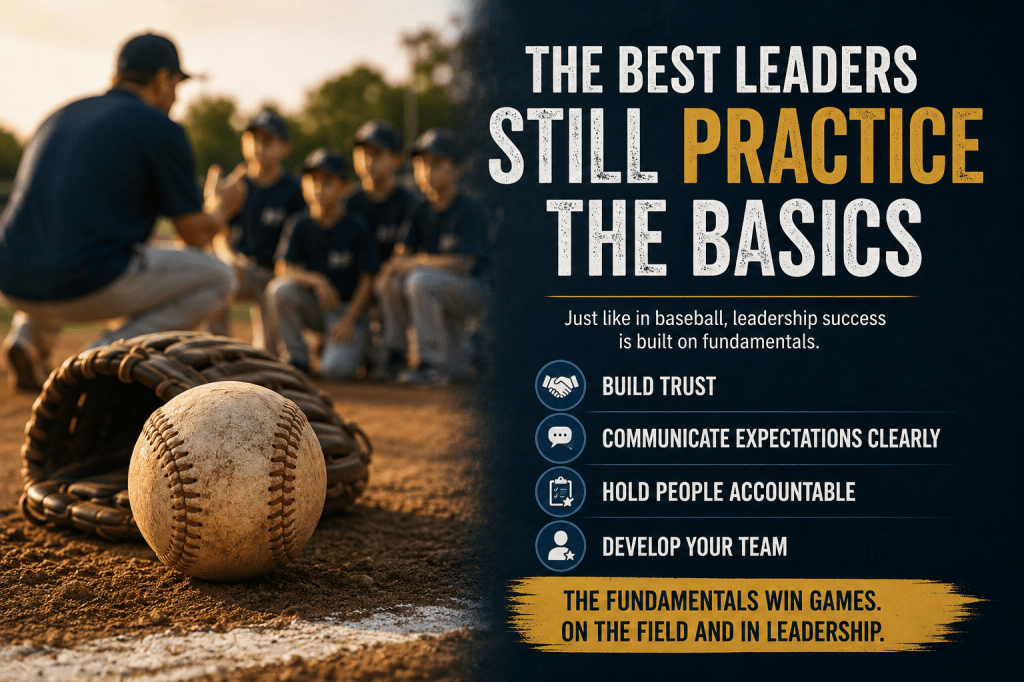
    The challenge, of course, is determining what leadership fundamentals actually are. Some may vary based on the organization, industry, or situation. However, I believe there are four leadership fundamentals that matter regardless of circumstances:
    Build trust
    Communicate expectations clearly
    Hold people accountable
    Develop your team
    These are the leadership equivalents of throwing, catching, and hitting.
    Too often, leaders become consumed with business results, financial metrics, strategic initiatives, and quarterly targets. While those outcomes matter, they are ultimately the result of leaders consistently executing the fundamentals.
    When leaders fail to build trust, communication breaks down. When expectations are unclear, performance suffers. When accountability disappears, standards decline. When employees are not developed, growth stalls.
    ust as championship teams are built on a foundation of fundamental skills, successful organizations are built on a foundation of fundamental leadership behaviors.
    The best leaders, like the best coaches, never outgrow the basics. They understand that fundamentals are not something you master once and move beyond. They are something you practice every day.
    Because in leadership, just as in baseball, the fundamentals win games.

  • I’ve written before that the ultimate goal of most youth baseball and softball teams is to win a championship. It might be a league title, a tournament championship, a state championship, or someday even the College World Series or Major League Baseball’s World Series. In a previous post, I talked about the idea of “winning the small moments to win the big games.” The point was simple: championships are usually the result of hundreds of small victories accumulated over time.

    This time, I want to focus on a different benefit of those small victories. Beyond helping teams win games, celebrating them helps create players who are fully engaged and invested in the success of the team. As players get older, the game becomes more detailed. Coaches spend less time teaching fundamentals and more time focusing on execution. Moving a runner from second to third with less than two outs. A hitter driving a fly ball deep enough to score a run. A player taking an extra base because they were paying attention and running hard. None of these moments are likely to make the highlight reel, but they often have a tremendous impact on the outcome of the game. The challenge is that players naturally gravitate toward the things that receive attention.

    If the only things we celebrate are home runs, strikeouts, and game-winning hits, players begin to believe those are the only things that matter. As coaches, we have to be intentional about recognizing the smaller contributions that help teams succeed. When a player executes one of those “little things” correctly, acknowledge it. Give them a high-five when they get back to the dugout. Let the team hear you praise the effort. Mention it during your post-game talk. By doing so, you’re reinforcing the behaviors you want repeated. The impact goes beyond the individual player. The entire team starts to understand what success looks like. They learn that moving a runner, making the cutoff throw, advancing on a passed ball, or laying down a sacrifice bunt are valuable contributions. Over time, players begin taking pride in those actions because they know they are noticed and appreciated.

    The same principle applies in the workplace. As leaders, employee engagement is critical to both team performance and organizational success. One of the most effective ways to build engagement is through recognition. Too often, leaders focus exclusively on the big wins: exceeding quarterly sales goals, increasing profits, landing a major client, or achieving a key strategic objective. Those accomplishments deserve recognition, but they shouldn’t be the only things we celebrate. What about the employee who receives a thank-you note from a customer? The team member who stays late to help a coworker? The individual who identifies a process improvement that saves time for the team? These moments may not move the stock price, but they contribute to the culture and performance that eventually drive larger organizational results.


    When leaders consistently recognize these smaller victories, they send a powerful message: “I see you. I value your contribution. What you do matters. “That’s how engagement grows.
    One employee at a time.
    One player at a time.
    One small victory at a time.
    https://dugoutleadership.com/2026/04/03/win-the-small-moments-win-the-big-games/

  • One of the biggest mistakes we make as coaches—especially as players get older—is assuming they’ve “mastered” the fundamentals. As youth players age and gain experience, we naturally spend less and less time reinforcing the basics. We move on to more advanced concepts, complex strategies, situational play, analytics, and game planning. Those things absolutely matter. But when the fundamentals begin to slip, everything else eventually starts to break down too.

    There’s a famous line in the movie Bull Durham where the manager tells his struggling team, “This is a very simple game. You throw the ball, you catch the ball, you hit the ball. Sometimes you win, sometimes you lose, sometimes it rains” While technically true, anyone who has coached the game knows there’s much more to it than that. There’s a right way to throw. A right way to catch. A right way to hit. The small details matter.

    When players are young, coaches spend countless hours teaching those movements. We work on footwork, glove angles, throwing mechanics, balance, timing, and repetition. But as players improve, coaches often shift their attention toward more complicated aspects of the game. In many ways, that’s more enjoyable for us as coaches. Advanced concepts feel more exciting. But it can also become dangerous if we stop reinforcing the basics that everything else is built upon.

    Years ago, I was an assistant coach at a local high school, and our head coach had what he called “everyday drills.” These were relatively simple drills that players performed every single practice—hence the name. On the surface, they looked basic. Some players probably thought they were repetitive or unnecessary. But over the course of a season, those drills made us a fundamentally stronger team.

    We fielded the ball better because the movements became automatic. We made fewer mental mistakes because the habits were ingrained. Players reacted correctly under pressure because they had repeated the fundamentals so many times that they no longer had to think about them.

    That’s the power of fundamentals. They create consistency.

    When teams lose sight of the basics and focus only on the “big things,” mistakes start to compound. Missed cutoff men. Poor footwork. Bad throws. Mental lapses. Games are rarely lost because of one massive mistake. More often, they’re lost because small breakdowns pile up over time.

    The same principle applies in leadership and business. Strong organizations are built on mastering the fundamentals. Communication. Accountability. Preparation. Follow-through. Customer service. Something as simple as how a team answers a customer phone call can shape the reputation of an entire company. If leaders fail to reinforce those basics consistently, small issues eventually turn into bigger problems.

    Whether in sports or leadership, success almost always comes back to mastering—and continuously reinforcing—the fundamentals.

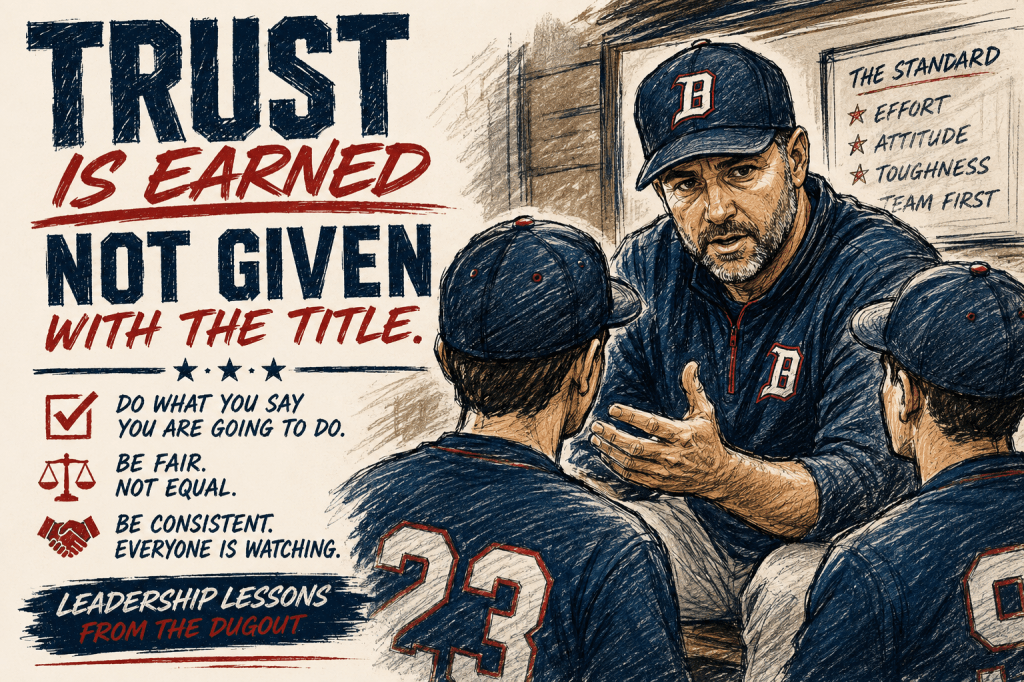
  • One of the biggest mistakes we make as coaches, leaders, and managers is assuming trust automatically comes with the title. Too often, coaches believe young players will trust them simply because they are the “expert” or the adult in the room. The reality is, trust does not come with a whistle, a lineup card, or a job title. Trust is earned through consistency, fairness, and follow-through over time.

    If we want to build trust with players, parents, employees, or coworkers, we have to provide a consistent approach and, most importantly, do what we say we are going to do.

    In baseball and softball, players notice everything. If I tell a player he is going to play a certain position and then I change my mind without explanation, I might get away with that once. Maybe even twice. But eventually, that player stops believing me. Once that trust starts to disappear, everything becomes harder. Communication suffers. Buy-in disappears. Effort declines. The player may still show up physically, but mentally they begin checking out.

    The same thing applies to the little promises we make to a team. If I tell players we are going to work on baserunning every day, but we continually skip it, eventually the team starts questioning my integrity. Players begin wondering if anything I say actually matters. Trust is not built through speeches. It is built through repeated actions that align with your words.

    Building trust also goes beyond simply following through. It applies to how consistently and fairly we treat people.

    Fair does not always mean equal.

    One of the most important lessons young coaches and leaders must learn is that every situation is different, but the standards must remain consistent. If the team rule is that players run out every ground ball or the team runs sprints afterward, then that standard has to apply to both your star player and your number nine hitter. The moment players believe the best athlete gets treated differently simply because they are talented, trust starts to erode across the entire team.

    At the same time, fairness also requires leadership judgment. If a player fouls a ball off his foot and cannot run full speed safely, that situation deserves context. Consistency is not about robotic leadership. It is about applying standards honestly while still recognizing circumstances.

    The same principle applies in the workplace. Employees quickly recognize inconsistency. If leaders allow one employee to ignore deadlines, skip meetings, or avoid accountability while holding everyone else to a different standard, trust within the team begins to collapse. People may not always say it out loud, but they notice.

    In both sports and leadership, trust is built in small moments long before it is tested in big ones. Consistency earns credibility. Credibility earns trust. And trust is what ultimately gives leaders the ability to influence, develop, and lead others effectively

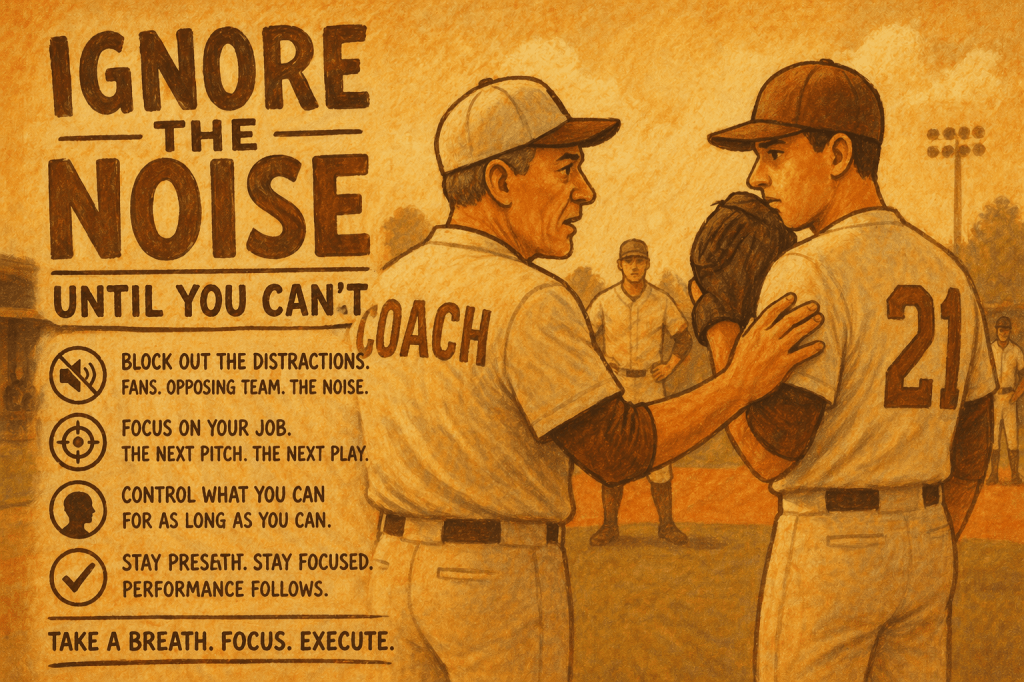
  • During any given game, it’s very likely that one of the few things you’ll hear me yell at a player is, “Take a breath and focus.” What I’m trying to remind them to do is simple—but not easy: block out all the outside noise—fan chatter, the opposing bench, runners on base—and lock in on the task at hand. Whether they’re in the batter’s box, on the mound, or in the field, I want players to focus on their specific job. Ignore everything else…until you can’t.

    In both youth and high school baseball and softball in my area, opposing dugouts can be very “chirpy.” Teams try to rattle each other by being loud—and sometimes, if we’re being honest, crossing the line. If you walk a batter, make an error, or strike out, you’re going to hear about it. That’s part of the environment. It’s not always right, but it is reality. And the players who learn to handle it best are the ones who gain a real competitive edge.

    The key isn’t pretending the noise doesn’t exist. The key is choosing not to engage with it.

    Great players develop the ability to narrow their focus. A hitter steps into the box and doesn’t think about the last at-bat, the score, or what the other team is yelling. They focus on one thing: the next pitch. A pitcher who just walked a batter doesn’t spiral. They take a breath, reset, and execute the next pitch. An infielder who just made an error doesn’t carry it into the next play—they get ready for the next ball hit their way.

    That’s what “ignore the noise until you can’t” really means. You control what you can control for as long as you can. But there are moments in a game where you do have to acknowledge reality—the runner stealing, the bunt situation, the game speeding up. At that point, awareness matters. But even then, it’s focused awareness, not emotional reaction.

    This lesson goes far beyond the field.

    In leadership, the “noise” just looks different. It might be office politics, outside opinions, second-guessing, or pressure from multiple directions. Leaders are constantly surrounded by distractions that can pull them away from what actually matters. The best leaders, like the best players, learn to filter it out. They stay grounded in their role, their priorities, and the decision in front of them.

    They don’t ignore everything forever—but they ignore it long enough to stay effective. Because performance—whether on the field or in the workplace—comes down to focus. The ability to slow things down, take a breath, and lock in on what matters most in that moment.

    So the next time things start to speed up, or the noise gets loud, remember the simplest coaching cue there is:

    Take a breath. Focus. And ignore the noise—until you can’t.

  • One of the best parts about both watching and coaching sports—at any level—is that there is no script. While patterns may repeat, no two games are ever exactly the same. The same is true in leadership. Situations may feel familiar, but the details are always changing.

    The best players and coaches understand this. They don’t rely on a fixed plan—they rely on awareness and adaptability. They recognize the situation in front of them, draw on past experience, and adjust in real time.

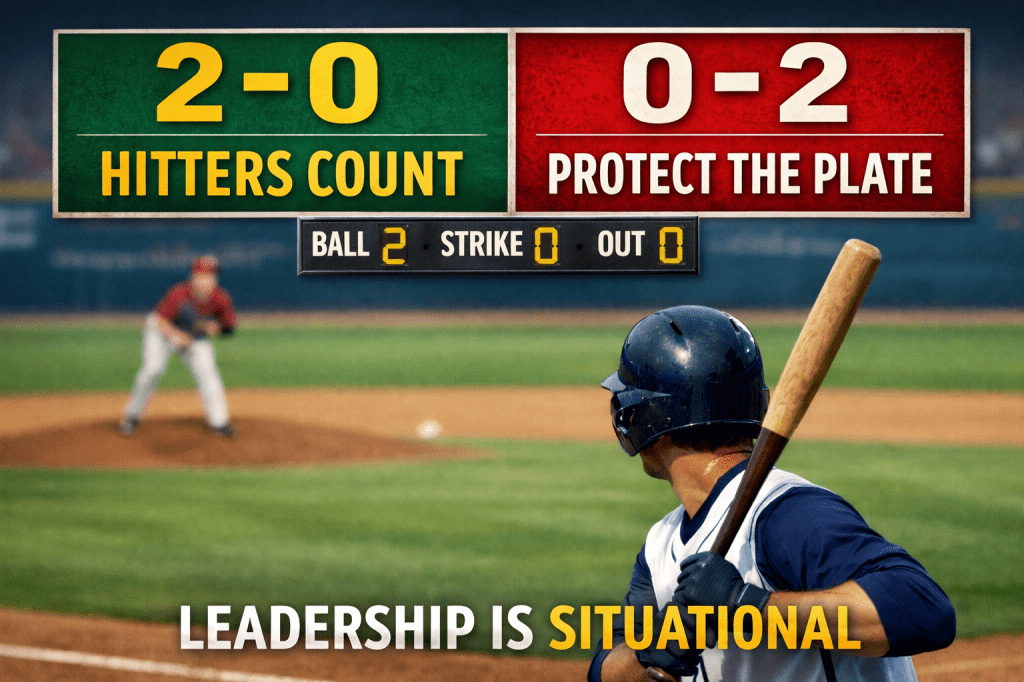
    In baseball and softball, one of the concepts I emphasize with more experienced hitters is “count leverage.” A hitter’s approach should change depending on the count. In a 2-0 count, the advantage clearly belongs to the hitter. That means being selective—looking for a pitch in a specific zone and refusing to chase anything less. On the other hand, in an 0-2 count, the situation shifts. Now the hitter must expand the zone, protect the plate, and battle to stay alive.

    Same hitter. Same at-bat. Completely different approach.

    That’s awareness. That’s adaptability.

    And it doesn’t stop with the count. Base running decisions, defensive positioning, and situational hitting all require players to read the moment. Should you challenge an outfielder with a strong arm, or play it safe and trust the next hitter? Should you take an extra base, or avoid making the third out? These decisions are rarely black and white. They require awareness of the situation and the discipline to adjust accordingly.

    The same principle applies in leadership.

    There is no scoreboard in the workplace showing balls, strikes, and outs. There’s no obvious indicator telling you exactly how to respond to a situation. Instead, leaders must pay closer attention. They must observe patterns, ask questions, and understand context.

    When an employee’s performance starts to slip, awareness matters. Do you immediately apply the same approach you used with someone else in a similar situation, or do you pause to understand what’s really going on? Are there external factors at play? Has something changed in their role, their workload, or their motivation?

    Adaptability matters just as much.

    Consider attendance. Do you respond the same way to an employee who is late for the first time as you would to someone with a consistent pattern? Effective leaders know that treating every situation the same isn’t fair—it’s ineffective. Consistency in values is important, but flexibility in approach is what drives results.

    Great leaders, like great players, don’t operate on autopilot. They stay present. They assess the situation. And they adjust.

    Because success—on the field or in the workplace—is rarely about doing the same thing over and over. It’s about knowing when to change.

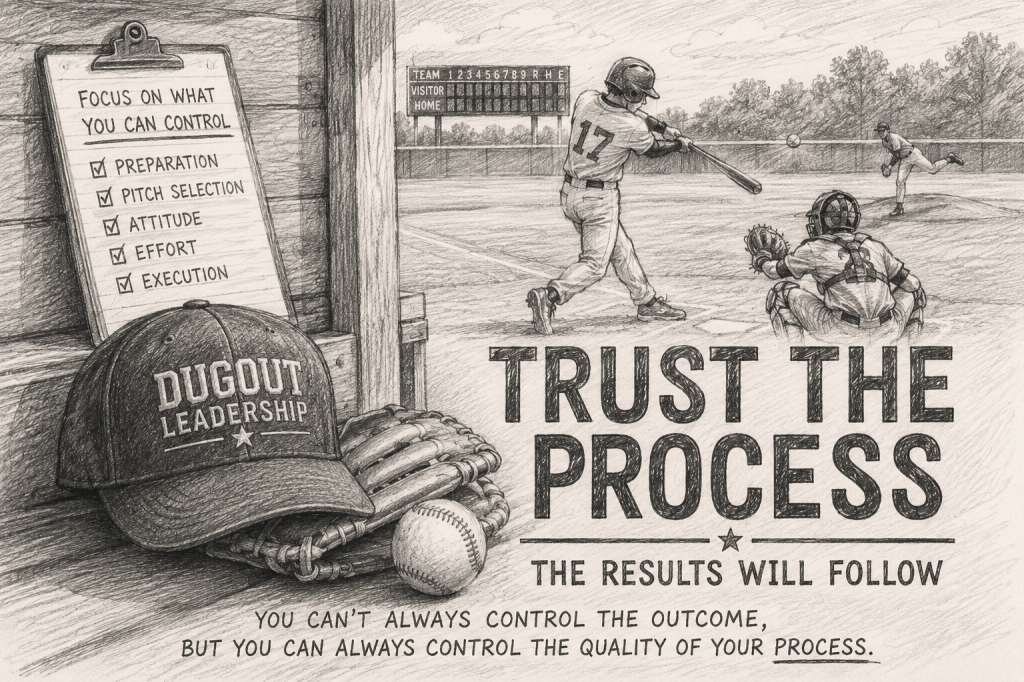
  • A Major League Baseball season stretches across 162 games. College baseball and softball seasons run around 50. High school and youth seasons may only reach 20. No matter the level, the ultimate goal is the same—win the World Series, the College World Series, or a State Championship. Those are the big results everyone sees. But what often goes unnoticed is how those outcomes are built.

    They are built on small wins. In baseball and softball, success isn’t created in a single moment. It’s constructed inning by inning, pitch by pitch. A well-executed bunt. A hitter working a full count and drawing a walk. A catcher blocking a ball in the dirt to prevent a runner from advancing. These moments rarely make highlight reels, but they change games. And games, over time, define seasons.

    The best teams understand this. They don’t just focus on the scoreboard—they focus on execution. They know that winning a championship isn’t about one big swing or one heroic play. It’s about consistently doing the little things right, over and over again. Move the runner. Hit the cutoff. Make the routine play. Control the count. Limit free bases.

    Each of these is a small win.

    Individually, they may seem insignificant. But together, they compound.

    The same principle applies in leadership. Most leaders are focused on big outcomes—hitting targets, improving engagement, driving results. But those outcomes are not created in quarterly reviews or annual plans. They are built in the daily interactions leaders have with their teams.

    A quick check-in. A piece of timely feedback.
    Recognizing someone’s effort.
    Holding a clear expectation.

    These are the leadership equivalents of winning a pitch.

    Great leaders don’t wait for big moments to lead. They win the small moments consistently. They understand that trust, performance, and culture are not built overnight—they are built through repeated, intentional actions. And just like in baseball, those small wins compound.

    Over time, they create stronger teams. Better habits. Higher standards. And ultimately, better results.

    The challenge—for both players and leaders—is discipline. It’s easy to get distracted by the big picture. It’s harder to stay focused on the next pitch, the next conversation, the next opportunity to execute well.

    But that’s where success lives. Not in the big moment—but in the accumulation of small ones.

    Because in the end, championships—and great leadership—are not won all at once.

    They’re won one small victory at a time.

  • Adjustments are Key to Success!

      In both baseball and leadership, our first attempt at something new rarely goes perfectly. In fact, sometimes it fails completely. But the real problem isn’t the failure itself. Failure is part of learning—we’ve talked about that before. The real problem is failing to adjust.

      Progress comes from the adjustments we make after things don’t go as planned.

      In baseball and softball, the best hitters separate themselves from average players not because they never fail, but because they adjust faster. If a hitter is late on a fastball, the result is usually predictable: a foul ball out of play. The important question isn’t what just happened—it’s what happens next.

      Some hitters step back into the box and simply hope they time the next pitch better.  But hope is not a strategy.

      Better hitters make adjustments. They might shorten their stride or eliminate it altogether. They may start their load earlier so their body is ready sooner. They might challenge themselves in practice by facing higher pitching speeds so the game begins to feel slower. Through trial, failure, and repetition, the adjustment eventually becomes second nature. The same principle applies in leadership. Many leaders struggle the first time they encounter certain situations. Maybe it’s delivering tough feedback to a direct report. Maybe it’s holding someone accountable for poor performance. Maybe it’s navigating a difficult conversation where emotions are running high. These moments rarely feel comfortable the first time.

      But leaders who improve treat these moments the same way great hitters treat an at-bat—they reflect and adjust.

      After a difficult conversation, it helps to pause and think about what went well and what didn’t. What would you handle differently next time? What questions could you ask earlier? How might you manage the emotional side of the conversation better?

      Leaders who take a few notes after these moments create a powerful learning loop. Over time, those reflections turn into better judgment, better timing, and more confidence.

      Leaders who simply “wing it” each time often find themselves repeating the same mistakes.

      But leaders who adjust grow stronger with every experience.

      Hard work matters. Effort matters. Preparation matters.

      But in both baseball and leadership, the real separator is adjustment.Good leaders work hard.

    1. It looks like the same drill, again. The same rep, again. The same uncomfortable moment where you realize you’re not as consistent as you thought you were. And in a world that celebrates quick wins, highlight reels, and “natural talent,” repetition can feel boring—or worse, unnecessary. But mastery is built in the reps.

      In baseball and softball no one accidentally becomes a great hitter. Even the best in the world fail most of the time. What separates them isn’t perfection; it’s preparation. They’ve seen the pitch before. Their body has felt that movement pattern thousands of times. Their eyes have tracked that release point in practice so often that the game feels slower. Repetition creates familiarity, and familiarity creates confidence.. And here’s the key: not all practice is equal.

      Mindless repetition just reinforces habits—good or bad. Mastery requires intentional repetition. That means doing the reps with feedback, with focus, and with a willingness to adjust. In coaching, that’s why we break skills down into parts. We slow them down. We exaggerate the right move. We create constraints that force the athlete to execute correctly. We film. We correct. Then we repeat again.

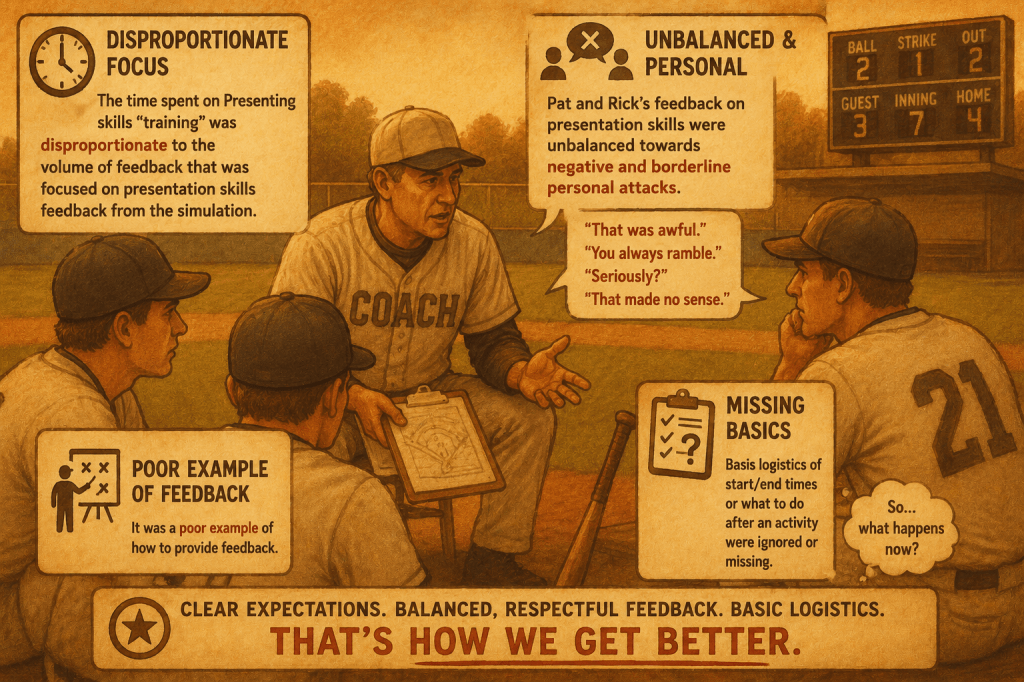
      In leadership, practice is just as important—but we often pretend it isn’t. We expect people to run effective meetings without ever practicing facilitation. We expect new managers to give great feedback without role-playing difficult conversations. We expect leaders to navigate conflict, coach performance, and drive change—often with no reps, no safe environment to learn, and no feedback loop.

      Then we’re surprised when they struggle.

      If we want mastery in leadership, we need to train it the way we train any skill: build reps in low-risk environments so people can perform in high-stakes moments. That’s where simulations, scenarios, and practice conversations matter. It’s why the best leadership programs aren’t lecture-heavy—they’re experience-heavy. They create repetition: practice, debrief, adjust, reflect.

      Repetition also builds trust.

      On a team, the people you trust most are the ones who are consistent. They show up the same way. They handle pressure. They do the fundamentals. That consistency is rarely personality—it’s preparation.

      So if you’re coaching athletes or developing leaders, here’s the challenge: Don’t just teach the concept. Design the reps. Ask: What does great look like? What are the fundamentals? What’s the smallest version of the skill we can practice today? How do we get immediate feedback? What’s the next rep? Because mastery isn’t a mystery. It’s practice—done on purpose—over time.

    2. At nearly every level of sport, standout performers are easy to identify. They are often more physically gifted than their peers, and it shows quickly—both in practice and in games. Sometimes it’s raw athleticism; other times it’s skill, instincts, or confidence. They may throw harder, hit farther, or field more cleanly, but one way or another, they separate themselves. These are your A players.

      As coaches, it’s natural to gravitate toward them. They enjoy extra work, progress quickly, and often make coaching feel rewarding. Quite frankly, A players can make us look like very good coaches. They respond to instruction, apply feedback immediately, and produce visible results.

      But teams are not built on A players alone.

      Most rosters include a mix of A, B, and C players—and effective coaching requires attention to all three. When we focus exclusively on our top performers, we risk neglecting the rest. If we don’t invest time and effort in our B and C players, that’s where they will remain. Worse, they may disengage altogether or seek out another coach who is willing to help them grow.

      The same dynamic exists in the corporate world. Leaders often rely on their “A players” for critical work, stretch assignments, and added responsibility. These are the people we trust to deliver results, so we give them more—and often keep giving them more—until they are stretched to the point of burnout or diminished performance. Meanwhile, B and C players are left underutilized. This doesn’t mean every employee receives the same opportunities, but it does mean every employee deserves some opportunity. Development requires exposure. Growth requires challenge. Leaders must be willing to test assumptions, offer stretch assignments thoughtfully, and see what others are capable of when given the chance. Great leaders—like great coaches—develop depth. They don’t just rely on their A players; they grow the Bs and Cs so tomorrow’s A players are already in the makin